‘I’ll give you twelve dinars for the necklace.’ Walid shakes his head sadly. ‘Oh all right then, fifteen. Fifteen dinars.’ A look of pain ripples across his face. ‘How much then?’ I ask, not wanting to cause offence.
‘No dinar! I don’t want your money. It’s a gift.’
Something very odd is happening. This is the fourth shop in Tripoli’s old town my friend Andie and I have walked into and so far we’ve failed to spend a single dinar. It’s not for the want of trying. It started in the market, when the man on the fruit stall handed us a large bag of dates and then refused to take payment. Then, in the patissierie, the boy with eyelashes as long as a camel’s shyly insisted that we take two pieces of baklava. And now Walid is fastening the beads around my neck and inviting us to have a cappuccino with him in his tiny Aladdin’s cave of a shop in the copper souk.
This wouldn’t happen in Marrakesh, I think to myself. But this is not Morocco, this is Libya, where tourists are still rare enough to be seen as a source of mild curiosity rather than wallets on legs. Against the deafening clang of hammers on metal from the surrounding workshops, Walid says something I am to hear several times during my stay here: ‘Your gift to us is that you visit us and then you go home and tell people that Libya is not a bad place. We are not bad people.’
Libya has come a long way since the dark days of the 1980s when the shooting of a WPC outside the Libyan embassy in London and the bombing of a Pan-Am flight over Lockerbie, turned it into a pariah state. Now, 37 years after he took control of the country, Colonel Gadaffi seems to want to polish its international reputation. In 2003 Libya officially took responsibility for Lockerbie and renounced its weapons of mass destruction programme. UN sanctions were lifted and tourists have been trickling in ever since.
To get a visa you need to book with a tour operator and it’s forbidden to travel around the interior without a guide. There are 11 of us in our tour group plus Stan, the tour leader, Milud, a local guide, and a portly young man with freckles and red hair. He doesn’t speak any English and, at first, nobody seems to know who he is, but Stan tells us that every time they go to the bathroom he shows Stan his gun and winks, so we surmise that he’s our armed guard. At least I hope that’s what he is.
The man Reagan nicknamed ‘mad dog’ may be mellowing in his old age, but this is still a dictatorship, albeit an eccentric one, run on quasi-socialist principles. Passengers arriving at Tripoli airport are greeted by political slogans (‘Partners not wage workers!’), and portraits of the leader in his trademark sunglasses gaze out from huge hoardings along the road from the airport. You can read all about Gadaffi’s ‘Third Universal Theory’ in the Green Book (along with his musings on religion, car rental, boxing and breastfeeding).
Green is the colour of the revolution. It’s the colour of the shutters and front doors of Tripoli’s grand Italianate buildings and of the flags fluttering in Green Square. It was from a balcony on the castle overlooking this square that Mussolini addressed the people during the Italian occupation of the city. The Italians are gone, but you can still get a decent espresso here.
Tripoli is a low-key and likeable place, bathed in clear North African light and cooled by breezes from the Mediterranean. Outside the walls of the old town, young men in combat trousers and designer sunglasses shop for trainers and DVDs, while old men sit drinking coffee in the shade of jacaranda trees. In Clocktower Square, the apple-sweet smell of shisha smoke hangs thickly in the air and Arabic pop music filters out from the cafes. To step inside the walls of the medina, the ancient part of the city, is to wind back the clock a couple of centuries. The narrow lanes each have a designated purpose or trade. In the spice souk, pale-skinned Berber women with tattooed chins shop for dried herbs, cinammon and ginger. Another street hums to the drone of sewing machines.
The deeper into the centre you burrow, the further back in time you seem to go. At one intersection I see four pillars built into the corner that look suspiciously like Roman columns. Of course, that’s exactly what they are.
The medina has been sinking slowly into dereliction since World War II, when it was damaged by bombs and many families left to live in the houses abandoned by the Italians. Today, the once beautiful buildings are occupied by poor migrant workers who have crossed the desert from Chad and Niger. As night falls, the shops are lit by candles.
Tripoli doesn’t have the snake charmers, the fire eaters or the heady exoticism of Marrakesh or Cairo. But nor does it have the hordes of tourists, the would-be ‘tour guides’, the pushy salesmen. It allows you the luxury of being an observer; of wandering undisturbed and taking it all in.
What it also hasn’t had - until now - is somewhere decent to stay. We stumble upon the Al Mundit Hotel while wandering around the medina. An old caravanserai where Tuaregs who had crossed the Sahara on camel would come to trade olive oil and wool, it has just 14 tastefully decorated rooms around a courtyard where tourists dine on tables strewn with rose petals. It’s the first hotel of its kind in Libya, a sign of the changing times, and has one of the best views in town, overlooking the Roman arch of Marcus Aurelius.
Libya’s Roman heritage is, quite literally, never far from the surface. And nowhere is it more spectacularly preserved than at Leptis Magna. A 90-minute drive east along the coast road from Tripoli, Leptis is Libya’s biggest tourist draw. Which makes it all the more astounding that on the day we visit, we have it entirely to ourselves.
Once a Phoenician trading port, it became one of the great cities of the Roman empire, its colonnaded streets, amphitheatre, temples and huge triumphal arch miraculously preserved by the sands of the Sahara. Today frogs hop across the intricate mosaic floors of the villas, weeds push up between the smooth paving stones, and the old Roman baths are filled with rainwater. In the forum, carved Gorgon heads stare down blindly and columns inscribed with Latin lie toppled on their side. The only sound that can be heard is the distant roar of the sea. There are no turnstiles, no barriers, no signs, no gift shop. Nothing to spoil the illusion that you are the first people in two millennia to have stumbled upon this portal to the past. It’s one of the most powerfully atmospheric places I’ve ever been, and it doesn’t take a great leap of the imagination to picture the original inhabitants going about their business. Their absence is almost tangible. At times I feel like I’m trespassing.
We fly south to Sebha, gateway to the Sahara, and are met by the drivers who will take us into the desert, led by Abdel, a six-foot-five Tuareg who cuts an imposing figure dressed head to toe in indigo, only his eyes peeping out from his blue headscarf. I jump into a jeep with Sanusi who has customised his dashboard with camel fur and, Tuareg tribal music blasting from the speakers, we head out into the desert, the road ahead stretching into infinity, the pylons seeming to follow the curve of the earth. After miles of monotony I spot a lake in the hazy distance surrounded by palm trees. ‘Water?’ I ask Sanusi. He smiles and shakes his head. ‘Mirage.’
We camp in the Akakus mountains, an eerie landscape of strange rock formations, close to the border with Algeria. While we put up our tents, the cook rustles up a dinner of camel and macaroni, which tastes better than it sounds. After dinner we sit around the campfire while the drivers sing and drum on plastic water carriers. They ask us for a song in return. There’s lots of embarrassed shuffling and coughing until one member of our group treats them to a rendition of ‘Any Old Iron’. They don’t ask us again.
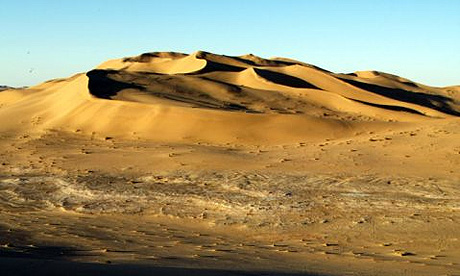
We spend the next two days exploring the more outlandish geological features of this area and stopping off at caves to admire the incredible rock art. Some of the paintings depict crocodiles, giraffe and elephants, which historians believe date them to 10,000 BC when the desert was a fertile savannah. On the third day we head north to Ubari. This is the Sahara desert of the imagination. They call it a sand sea and it’s an apt description for there is something liquid about the way the dunes undulate. As the jeep lurches up and over the endless, soft, rolling peaks, I even start to feel seasick.
We set up camp and climb to the top of a nearby dune, sinking knee-deep into the warm sand, to watch the sun set. The silence is total. There’s no birdsong, no breeze. Not a tree or a road or even a vapour trail in the sky. Just sand and blue sky. I sit down next to Charles, one of my fellow travellers. ‘I’ve waited my whole life to see this,’ he says quietly.
That night I finally pluck up the courage to abandon the tent and sleep under the stars. I see enough shooting stars to run out of wishes, and wake in the cold grey dawn to find countless little paw prints of various shapes and sizes decorating the sand around me.
Piles of litter by the roadside tell us we are leaving the desert the next day. But there’s one last treat in store before we tip the sand out of our shoes. The Ubari Lakes are oases fed by underground rivers, which sit like miracles in the middle of the desert. Gebroun, the largest, is surrounded by reed beds and palm trees, and has spawned a minor tourism industry. There’s a ghost village of mud-brick houses where Tuareg salesmen display silver jewellery, and a few cafes selling cold drinks. After a couple of days in the desert, I had fantasised about diving into the cool water, but when I get up close I find it’s oily and stagnant.
Back at the airport in Tripoli I make a last valiant attempt to spend my remaining dinar. But it’s no good. The man in the kiosk has other ideas. ‘You come into my shop. Take what you like! Christmas present!’ I leave Libya with a heavy heart and a singing camel under my arm.
The 60-second guide to Libya
History: In September 1969 an obscure group of military personnel, led by Muammar Gaddafi, seized power in Libya from King Idris and the Socialist People’s Libyan Arab Jamahiriya was born. After a long period of isolation and sanctions, diplomatic relations have been resumed with Libya and the private sector is slowly opening up, attracting more foreign investors.
Practicalities: Around 2,000 British nationals visit Libya every year. To obtain a visa you need to book through an accredited tour company, and if you plan to explore the interior you’ll need to travel with a guide. You require prior permission from the Libyan authorities if you intend to travel to the desert regions. Your tour operator will usually be able to arrange this for you. Libya is a cash society; credit cards are not widely used and there are few reliable ATMs in Tripoli. You must be in possession of the foreign currency equivalent of at least 500 Libyan dinars (about £200) on arrival. Mobile phone reception is patchy at best (and non-existent on some networks, such as Orange).
Safety: Crime levels are very low and you’ll feel safe walking around Tripoli. The British Embassy advises against all but essential travel to all areas bordering Chad and Sudan, because of instability in the region.
Highlights: Most organised tours of Libya will include visits to Tripoli, the Roman ruins at Leptis Magna and Sabratha on the coast and an excursion to the desert with overnight camping. Longer itineraries might feature excursions to the ancient Greek city of Cyrene in the north-east of the country and to the oasis town of Ghadames. During your stay in the capital, be sure to allow time to visit the medina and the excellent Jamahiriya Museum, which has an impressive array of antiquities from the Phoenician, Cyrenian, Roman and Byzantine periods.
Essentials
Joanne O’Connor travelled with Wild Frontiers (020 7736 3968) on its nine-day Libya Unveiled itinerary. It costs £1,450, including accommodation, meals, transport, guides, entrance fees and BA flights and departs next on 24 March and 10 November. Photographer Grant Fleming flew with Afriqiyah Airways (01293 596638).
