
1. Get on a bike
Although Copenhagen is a great city for pedestrians, if you really want to feel like a local (and you're keen on avoiding aching feet), rent a bike and take to the city's wide cycle lanes. Cycling is integral to the Danish capital's culture - so much so that one of the first things you will witness is the sight of tow-headed youngsters being pedalled around in "pram bicycles", a unique form of conveyance manufactured solely in the free state of Christiania (see below). Even the normally bike-shy will find that joining the ranks of cyclists around this peaceful, beautiful capital is child's play.
2. Cross the Baltic - by bridge
If you didn't arrive this way (Ryanair does cheap flights to Malmo if you're interested) it's worth taking a half-day trip out to Sweden over the new Øresund fixed-link bridge - a train and tarmac, bridge and tunnel combo spanning 17km across the Baltic and connecting the two countries. The train from Malmo to Copenhagen central station takes about 45 minutes and costs 120 Danish krone (DKK) - around £6 each way.
Opened on time and to budget last year, the experience of taking an air-conditioned electric train over miles of glistening sea and bobbing yachts is breathtaking. Consequently, the bridge has seen a huge flux of traffic, although it has been largely one-way. During the first 12 months, 25% of Swedes made the journey over the bridge into funky, laid-back Denmark, but the Danes failed to exhibit a similar enthusiasm for visiting Sweden: just 4% took the train the other way.
3. Drop in at Tivoli
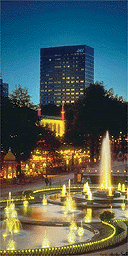
As a cultured backpacker, it's quite tempting to ignore Copenhagen's big crowd-puller, Tivoli. But the pleasure gardens are at the epicentre of the national psyche - no childhood in Denmark is complete, apparently, without a visit to this fairytale land. To be fair, it's not tacky, but it isn't exactly cheap either, and with a smallish selection of rides alongside the gardens, alfresco concert areas and expensive restaurants, it's probably best visited as a family affair. Going at night certainly adds to the magic, and trying out the 64m-high 'Det Gyldne Tarn' (essentially a pole with chairs attached that raises you up then drops you like a stone) allows you to appreciate the Copenhagen skyline - for approximately two seconds. The following two seconds (which seem to last for several lifetimes), as you plummet to what your body and brain quite reasonably expect will be your death, allow you to appreciate your partner/children/parents/job/health etc.
4. Take a peek at something sexy
The Museum of Erotica is a tawdry, naff and exploitative affair, where you'll see more furtive American tourists and Brit couples than writhing, naked bodies. If you feel that £8 is too much to pay for a look at some mouldy posters of Marilyn Monroe and a few historical artefacts, you'd do better to visit any of the sex shops around the station. Since hard-core was legalised in Denmark in 1967, these shops have thrived on the back of the Danes' liberal placidity.
5. Get close to royalty
The royal palaces of Amallenborg Slot are excellent if you fancy a wander over some cobbles and, unlike our own queen, the Danish Margrethe II is available by appointment to meet any of her subjects. That this country, possibly the most egalitarian in the world, still supports a monarchy could be something to do with the 61-year-old monarch's remarkable track record - one of her more noteworthy achievements was to translate the works of Simone de Beauvoir into Danish.
The day we were there, a drunk punk parked his car outside the palace and played "We are the Champions" at full volume. Nobody batted an eyelid. Try doing that outside Buckingham Palace.
6. Tune in, turn on, drop out
At the other end of town, and the opposite end of the social spectrum, is Christiania, a former Victorian military barracks which was taken over by ecologists, hippies and drop-outs in the early 70s and, 30 years later, is still going strong. Within the car-free compound of Christiania are some of the best cafes, restaurants and clubs in Copenhagen - not to mention probably the most innovative bike shop in the world.
In the "Loppen" complex - a Victorian warehouse converted into a restaurant, club and art gallery - I experienced one of my greatest dinners ever: reindeer meat, with berry and aniseed sauce, on roasted organic mushrooms. The Spieseloppen restaurant, a candlelit room with stripped floorboards where joints are permitted, has a rotation of international chefs who write, photocopy and prepare a fresh menu each evening.
Christiania also offers grass and hash sold cheaply and calmly from stalls on a stretch of ground known as "Pusher Street". Despite the ominous-sounding address, no hard drugs are on offer, and the place throngs with tourists, dopeheads and ordinary Copenhageners picking up their supplies. Officially, cannabis is illegal in Denmark, but it is smoked openly here, and you can regularly smell it in other parts of town. As a free state, Christiania officially has no laws and pays no taxes, but as a precaution, photographs of the stalls are not permitted.
7. Climb a steeple
The amazing steeple of the Vor Frelsers Kirke church, next door to Christiania, features a narrow, external spiral staircase disappearing into the sky. Probably best attempted before a visit to Pusher Street.
8. Take in some wildlife
If you're in town for more than a day or two, and you don't disapprove of such things on principle, Copenhagen's 142-year-old zoo offers a delightful afternoon out. More like a Victorian ornamental garden than an animal complex, you nevertheless come face-to-face with lions, polar bears and panthers as you round every corner. Spotting the camouflaged snakes and centipedes in the foliage in the tropical den - a gloomy, humid building housing bizarre spiders, frogs and ants - is quite a challenge.
9. See some art
Personally, I found the Statens Museum for Kunst disappointing for its contents - too much national art for the sake of it - but worth a visit for the stunning, scale-defying architecture of the building. Essentially a Victorian culture palace, the new, white, marble-and-glass extension makes a mockery of the concept of "blending in" and attaches itself to the exterior wall of the old building by means of a five-storey glass corridor complete with vertigo-inducing internal glass walkways in the sky.
In contrast comes the Ny Carlsberg Glyptotek - the collection of one of the original, philanthropic 19th century brewers - which contains some truly fabulous Egyptian and Roman artefacts. It was described as the "Museum of Greek and Roman People Standing" by one apologetic but nearly fluent Dane when we asked directions. A fairly ordinary Gothic piece of Victoriana from the outside, it also houses a winter botanical garden and Kai Neilsen's bizarre "Water Mother With Children" sculpture, in which 17 infants are depicted crawling over a recumbent earth mother.
10. Boat it to Bornholm
A 30-mile-square island seven hours by ferry from Copenhagen in the middle of the Baltic, this tiny island is crammed with everything except cars: Viking burial mounds, quiet sandy beaches, medieval churches, forests, hills and caves and - if you're feeling peckish - plenty of traditional herring smokehouses.
This is where Danes come for cycling holidays, and any cyclist will be glad to have made the excursion. With tracks leading through rolling farmland, along the coast and through forests, it's THE place to feel the wind in your hair.
Most farms have stalls selling wild strawberries (kartofflen) for around 18DKK a carton, with an honesty box nearby.
Be warned, however - it's no place for nightlife beyond a wander along the beach under the Baltic moon, and most towns have little more than a single pizza parlour. But taking the night ferry from Copenhagen is a romance in itself, as you float past churches, squares, docks and wind turbines (ferries leave directly from the cafe-lined streets of the city centre) until the picture-book Gothic skyline retreats into the dusk. A foot passenger return costs about £60, and the price includes a sofa bed on the ferry (which is more like a cruise liner than our cross-Channel affairs). Ticket offices are on the harbour - advance booking is advised but not strictly necessary.
11. Go bar-hopping…
Most of the bars serve extremely good, varied food - restaurant standard, in fact, just slightly less formal - although the local lagers, Tuborg and Carlsberg, are nothing to write home about. Service is invariably from the bar and, in the bars where the pretty people hang out, you will pay London prices. Still, unlike in London, you're guaranteed pretty people.
Try Bankerat at Ahlefeldstgade 27-29. The guide book calls it grungy and bohemian, but it's even better than that. Café Klimt, at Frederiksborggade 29, is fantastic for food, as well as lounging over a drink.
12. …and dance Nightlife and clubbing is as stylish, sexy and egalitarian as you come to expect after catching sight of hundreds of stunning people whizzing by on their bikes all day.
My favourite clubs were Rust and Vegas, both great value at a fiver to get in. Rust is a beautifully designed Cubist block on three levels, with funky house DJs, and regular live gigs. Vegas is a renovated 1950s office block, with wood panelling and fitting in true Arne Jacobson style, and it also pumps out the most cutting edge tunes on Copenhagen's largest dancefloor.
Or try the middle floor of the Loppen complex in Christiania, with live gigs most nights of the week, and a DJ taking over until at least 4am.
