
It pays to be flexible
You've probably got a good idea of where you want to go while you're away, but take your time to shop around and listen to other people's ideas.
As a general rule, how much you pay for your ticket will depend on when you leave the UK, how many stops you make en route, and how popular those stops are - the more frequented the destination, the cheaper the flight. It also costs less if you keep flying in a continuous direction round the world. If you're lucky, your chosen route will follow one of the airlines' ready-made itineraries - if not it may be worth changing route slightly to fit in, because these off-the-peg routings are usually better value.
Insurance is worth it
When you're on a tight budget, paying a few hundred pounds for something you may never need seems like an extravagance, but skimping on insurance is a risky business. If you have an accident while you're away, you could be hit with bills running into hundreds of thousands of pounds.
You can cut corners, though. A number of companies offer policies aimed specifically at cash-strapped backpackers - luggage and belongings aren't covered, but the all-important medical aspects are. usit Campus (020-240 1010, www.usitcampus.co.uk) sells Go Banana Travel Insurance, offering worldwide cover for 12 months for £270 (excluding baggage), £349 (including baggage and some hazardous pursuits) or £439 (their most comprehensive cover).
Don't just go automatically for the cheapest policy. And boring though it is, you should read the small print and check exactly what you are and aren't covered for.
You should choose your companion with care
Travelling on a budget with a friend is a big commitment. So ask a few key questions before you commit yourself:
* Do you have similar interests? (You needn't like the same things all the time, but if one wants to go clubbing till 3am every night and the other likes to rise at dawn for early-morning meditation, it's not a good start.)
* What's their budget? (It's important to have roughly the same amount of money - and the same ideas about how to spend it.)
* Are you agreed on how long to stay away?
* Is your friend normally cheerful and optimistic?
* How flexible are you?
Keeping in touch with home is easy
The internet has changed the face of backpacking forever. Poste restante can be hit and miss, but e-mail makes sending and receiving messages a doddle. There can be few places left in the world where you can't get internet access.
All you need to do is set yourself up with an address that allows you to access your e-mail anywhere in the world. Lots of companies offer such services, and two of the most popular with backpackers are Hotmail (www.hotmail.com) and Yahoo! Mail (www.yahoo.com), both free. Just visit their websites and register, then, wherever you are in the world, you can log in your name and password and collect mail from any computer linked to the internet. For addresses of cybercafés around the world, visit www.netcafeguide.com.
It's not as scary as some people think
After reports in recent years of tourist kidnappings and murders, it's not surprising if potential backpackers (and their parents) feel a bit nervous. But most travellers come home having experienced nothing worse than the occasional rip-off.
Most crime is opportunistic, and just using your common sense will lessen the risk of falling prey to thieves or muggers. Remember, though, that no matter how tight your budget, you're rich compared with most people you meet in many countries, so you're an obvious target. Be particularly vigilant during the first week or two - you're at your most vulnerable when you arrive in a strange country tired, jetlagged and not yet in the travelling groove.
Unfortunately, fellow travellers are among the main culprits when it comes to theft, so keep a close eye on your possessions when staying in shared accommodation. Don't wear expensive jewellery or carry anything of great sentimental value - if you couldn't bear to lose it, don't take it. A money belt is the safest place to keep passport, money and valuables, but for everyday spending keep some cash in a pocket or purse. Don't flash your secret stash every time you buy something.
Travel light
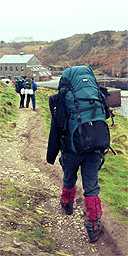
Lugging a heavy rucksack around in hot climates can be hell. So be ruthless about chucking stuff out. Don't take too many clothes - you can pick up things easily and cheaply en route. The classic traveller's packing tip is to lay out everything you're planning to take with you - then halve the amount of clothes and double the money.
If you're travelling with a friend, divvy things up between you. You take the antiseptic cream if they carry the alarm clock; you take the tent while they carry the poles and pegs, etc. Once you've filled your pack, pick it up and carry it round for a while. You might think it's fine at first, but after five minutes it could be a different story. As a general rule of thumb, carry no more than one third of your body weight.
It helps to plan ahead...
Ideally, you should allow at least a couple of months to organise your trip. Some countries take a couple of weeks to process your application, and if you have to get several visas you could find yourself running out of time. Always take great care filling in the forms because any errors or omissions can mean it takes longer to process.
Book an appointment with your GP or travel clinic a couple of months before you go, to sort out which vaccinations you need and when. It's no good leaving it to the last minute - some vaccinations may have to be given over a period of weeks or even months to be fully effective. For up-to-date health information on the countries you're going to, contact MASTA on 0906 8224100 (60p/min). Go to the dentist for a check-up, too, and allow enough time for any follow-up treatment you might need.
Check your passport has enough time to run - many countries insist that it's valid for at least six months beyond the date of entry. Check the expiry dates on your credit cards, too, and order new ones if necessary.
...but not too far ahead
It is a good idea to book your first night or two's accommodation - the last thing you want at the end of a long-haul flight is to be trekking around looking for somewhere to stay - but after that it's better to go with the flow. Commit yourself to too many fixed dates and destinations in advance and you could easily end up missing out on things along the way.
Don't get so excited about the great flight deals around that you forget to build in overland travel. If you fly everywhere you'll miss out on getting a real sense of the countries you're visiting.
You don't have to learn the language - but it helps.
You feel less at the mercy of others - and they're always delighted that you've made the effort.
The hardest part is coming back...
If you're worried about how you'll cope while you're away, don't be. Once you're out there, everything falls into place. The bit that surprises many people is coming home. After the initial excitement of seeing friends and family again, it can suddenly feel like a huge anti-climax. The cost of going out is a shock; friends quickly tire of travelling tales; and you'll miss the travellers' camaraderie you've got used to.
Time your return for summer if you can. Coming back in winter can be depressing. If you find it hard being in one place all the time, after being used to being on the move constantly, start going away for a few weekends. If all else fails, start planning your next trip...
Up to date in canvas city
With extras such as the free use of bicycles, canoes and windsurfers sometimes thrown in, camping can be an unbeatable money saver. While the best deals are inevitably outside the school summer holidays, even in the peak weeks of July and August a family of six can get a holiday in France for less than £1,000.
Nor does that mean roughing it. Modern fixed tents have sprung beds, electric lights, cookers with grills - though you may want to spend some of the money saved on eating out - and fridges to keep the Kronenbourg and Muscadet chilled. Mobile homes on campsites cost a little more but have showers and toilets.
Holiday operators include:
* Eurocamp (01606 787787, www.eurocamp.co.uk): tents and mobiles homes in France, Italy, Spain, Croatia, Austria, Switzerland, the Netherlands, Luxembourg and Germany.
* Canvas Holidays (08709 022022, www.canvas.co.uk): tents and mobiles homes on sites mainly in France but also Spain, Italy, Luxembourg, Germany and (mobile homes only) Austria.
* Select France (01865 331350, www.selectfrance.co.uk): tents and mobile homes mainly in western France but with one at Sarlat, in the Dordogne.
* Carisma Holidays (01923 284235, www.carisma.co.uk) specialises in tent and mobile home holidays "for the Franco-phile" - on the west coast but away from the busy sites.
* Keycamp (0870 7000123, www.keycamp.co.uk): tents and mobile homes in France, Italy, Spain, Austria, Switzerland, the Netherlands, Luxembourg and Germany.
* Sunsites (01606 787555, www.sunsites.co.uk): mobile homes, mainly in France but with one site near Tarragona on Spain's Costa Dorada.
* Supersites (01903 748166): mobile home in Brittany, Normandy, Languedoc and the Cte d'Azur. Special deal: 10 days at end of July £1,000 for up to six including Dover-Calais Hoverspeed crossings.
* Matthews Holidays (01483 285213, www.matthewsfrance.co.uk): mobile homes in Britanny and the Vendée, and on one site in southern France, near Perpignan.
* Becks Holidays in France (01273 842843): mobile homes in Brittany, the Vendée, Royan and the Dordogne.
* Ian Mearns Holidays (01993 822655): fixed tent and mobile homes in Brittany, the Vendée, Gascony and the Dordogne.
* Motours (01892 677777, www.motours.co.uk): mobile homes in France, Spain, Italy and the Netherlands.
* Select Site Reservations (01873 859876, www. select-site.com): reservations for sites, crossings. It also arranges insurance for both campers with their own equipment and caravan owners.
* Direct Travel (020-8641 6060, www.directtravel.co.uk): mobile homes in Brittany.
* Eurosites (0870 7510000/ www.eurosites.co.uk): tents, mobile homes in France, Italy, Germany, Holland, Luxembourg and Spain.
* French Freedom Holidays (01724 847530): mobile homes on the French west coast.
* French Life (0870 4448800, www.frenchlife.co.uk): tents and mobile homes, mainly in western and southern France.
* Haven (0870 242 7777, www.haveneurope.com): tents and mobile homes in Brittany, the Vendée, Aquitaine, Languedoc, on Cte d'Azur and in Spain and Italy.
* Mark Hammerton (01892 525456, www.markhammerton.com): tents, mobile homes in Brittany, the Vendée, Royan, Sarlat in the Dordogne.
* Sandpiper (01746 785123, www.sandpiperhols.co.uk): tents and mobile homes in western France.
* Solaire (0121-778 5061, www.solaire.co.uk): tents, mobile homes in Brittany, the Vendée, Royal, Biarritz and one site on the Costa Brava.
* Sunflower (01492 572 714, www.sunflowerhols.com): mobile homes in France.
* Welcome Holidays (01695 574 578, www.welcome-holidays.co.uk): mobile homes in Normandy, Brittany, the Vendée, Royan, and the South of France.
