
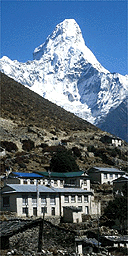
An Alpine meadow bright with spring flowers, an Atlantic clifftop with the cool wind in your face, a hot thyme-scented hillside with the blue Mediterranean in the distance, an exhilarating day among views of icy Himalayan peaks: now's the time to start thinking about your next walking trip.
You can walk almost anywhere these days, from the weird volcanic landscapes of Iceland to the mule paths of the Atlas mountains or the Inca trail in Peru. Closer are the mountains and moorlands of Britain and Ireland, and the excellent footpath networks of western Europe.
You can spend £2,000 or more on an organised fortnight in the Himalayas or Patagonia, or a few hundred camping along the Pennine Way or crossing the Welsh mountains. For less than £1,000 you can spend a week among beautiful landscapes in Spain or Italy or France, staying in small hotels and having your gear transported for you.
Some people's idea of walking is a solo backpacking yomp through the empty quarters of Scandinavia, getting high on solitude. More people go in family groups or for a sociable group walk, with a leader, taking the opportunity to meet new people.
There are two basic types of walking holiday: the guided groups, and the self-guided itineraries. One of the leading companies for guided group walking is Ramblers Holidays (01707 331133, ramblersholidays.co.uk), a commercial offshoot of the Ramblers Association. It offers around 150 holidays all around the world ranging from city sightseeing to mountain walks with ice axes and crampons: prices start at about £200 for a brief trip to the Lake District to £4,000 for a 39-day round-the-world walking trip.
If you have a large party or want special attention, some companies will organise a trip specially for you - which will of course be more costly.
The need for a guide is stronger in more remote countries and more extreme landscapes, including parts of the Alps and Pyrenees. A good local guide can also enhance your enjoyment of more gentle landscapes, especially the flora and fauna. But many people choose "self-guided" or independent walks so they can discover things for themselves and go at their own pace.
UK and Ireland
Long-distance paths offer a huge variety of continuous walking routes, ranging from a few days to several weeks, and most have a thriving parallell B&B industry. Most obviously, there are the 13 well-maintained and waymarked National Trails: the Pennine Way (251 miles), Offa's Dyke along the England/Wales border (178 miles), the Pembrokeshire Coast Path (186 miles), the South-West Coast Path (600 miles), the Cotswold Way (103 miles), the Ridgeway (85 miles), the South Downs Way (101 miles), the North Downs Way (142 miles), the Thames Path (180 miles), the Peddar's Way and Norfolk Coast Path (94 miles), the Wolds Way (79 miles), the Cleveland Way (110 miles) and Hadrian's Wall Path (81 miles, but closed at present because of foot-and-mouth disease; see englandgetaway.com for latest updates).
There are many guides to the trails, among the best of which is the Aurum Press series, which contains extracts from Ordnance Survey maps. They are run by the Countryside Agency (countryside.org.uk).
But the trails are the motorways of the system, and there are dozens of other interesting long-distance routes, ranging from the West Highland Way from Glasgow to Fort William, the Coast to Coast route across the north of England and the Cambrian Way, a 275-mile south-north mountain conoisseur's route through Wales. The most comprehensive directory is the Long Distance Walkers' Handbook (A&C Black, £11.99, Long Distance Walkers Association website is ldwa.org.uk), which lists 545 routes, some of rather fringe interest, such as the 18-mile Haematite Trail in Cumbria which explores the remains of iron mining near Barrow-in-Furness.
There is excellent walking in Ireland, particularly in the more mountainous west, and a range of 31 waymarked long-distance routes include the Wicklow Way near Dublin, the Dingle Way and the Sheep's Head Way, which circles one of the south-west peninsulas. Good booklets and information about holiday companies are available from the Irish Tourist Board (08000 397000, ireland.travel.ie).
Europe
Some of the most rewarding destinations are close and convenient: France, Austria and Swizerland are favourites, but companies and tourist organisations in Spain, Portugal, Italy and even the Czech Republic are opening up more walking country. There is useful information on walking in Europe on gorp.com.
The network of GR ( grande randonnée ) footpaths in France is especially good, offering routes such as the GR5 through the southern Alps from Lake Geneva to Nice. The French IGN map series no 903 gives a national overview of GRs and is good for planning.
European islands are especially attractive, not least because you can jump in the sea after a hard day: Sardinia and Sicily are good, Cyprus and the Canary Islands are improving their path networks, and Madeira has its special feature of the paths by mountain irrigation channels, the levadas. The jewels are probably Corsica, Majorca and Crete, with their spectacular mountains, gorges and and dramatic coastlines. The GR20 path along the spine of Corsica is a classic mountain walking challenge, hot and rough.
Many people work out their own route, carry their own gear and camp or find small places to stay each night. Companies which do the organisation for you and move your gear from hotel to hotel make their pitch to an older, more affluent age group. They include Headwater (01606 813333, headwater-holidays.co.uk), which offers independent walks in France, Italy, Greece, Switzerland and Malta, and guided walks to the first three of those plus Cyprus, Czech Republic and Morocco. Inntravel (01653 629010, inntravel.co.uk) has a good reputation for customer care and specialises in independent walks in Europe, including Norway, Portugal and Austria.
Worldwide
Some of the more remote and adventurous walks, like Everest Base Camp and Kilimanjaro, are part of the range offered by Exodus (020-8772 3812, exodus.co.uk), a market leader in group holidays for younger people. Other companies providing worldwide walking and trekking holidys are Guerba (01373 858956, guerba.com) and Travelbag Adventures (01420 541007, travelbag-adventures.com).
There are extensive hiking opportunities in the US, where the most famous long- distance routes are the Appalachian Trail (2,160 miles, pcta.org), and the Pacific Crest Trail (2,650 miles, fred.net/kathy/at.html), which runs the length of the Rocky Mountains. There are another six long-distance trails in the US, including the Pacific Divide Trail. One company that specialises in the US, Canada and Mexico is Trek America (0870 4448735, trekamerica.co.uk).
Books and maps
Stanfords in London (020-7836 1321, stanfords.co.uk) is probably still the best bet. But there are other shops, like the National Map centre (020-7222 2466, mapstore.co.uk). You can buy most maps on the net through mapsbymail.co.uk.
Decent maps are not always available for less developed countries, which in this sense includes places like Greece and Cyprus. That's when good guide books are at a premium. There are some specialist travel bookshops, like Stanfords and Cordee in Leicester (0116 2543579, cordee.co.uk). Cordee has a huge range of walking guidebooks, including new translations of a good series of walking guides from the German publisher Rother: these have filled important English-language gaps with volumes on places such as Sardinia and La Palma, the greenest and westernmost Canary Island. They do not stock the series by Cicerone Press (01539 562069), which has a wide range including guides to the Alps, the Pyrenees, and Corsica as well as British routes. Sunflower Books do a good series on walks in places Crete and Madeira.
