
The first time you need your camera ready is on the dark car deck when the ferry docks. As the passenger ramp begins to lower, a sailor jumps on to it - and there suddenly the view is, in a burst of light behind his silhouette: a town spread out like a honeycomb up an eight-mile valley under grey mountains.
"A town of white, pink, silver and gold glinting in brilliant sunshine... against a sky the colour of forget-me-nots." That was how the British author and broadcaster Faith Warn first saw it five years ago, on an off-the-beaten-track package trip that led her to stay for good.
The rest of us just tend to say, "Wow". The town is Pothia, capital of the eastern Aegean island of Kalymnos. There are further "Wow" moments to come. One, if you're heading by cab towards the western beach resort of Myrties, is when the cliff road turns a corner and the neigbouring mountain island of Telendos rears up at you out of the sea, as dominant in its setting as Mount Kilimanjaro is in Tanzania, with the gigantic profile of a woman etched into its side. Sharp rocks form her teeth and the whole mountain is the mantle of her hair; behind her is one of the finest sunsets in the Mediterranean.
Another moment, further to the east of Kalymnos, is the startlingly perfect azure-blue of the fjord-like, sea-flooded gorge that runs into the sheltered valley of Vathi, where early-season tomatoes, cucumbers, oranges and tangerines grow on volcanic soil. And yet another is your first taste of a Kalymnian tomato.
In the week we were there, however, for what began as an ordinary trip like Faith Warn's, a very select group of people was saying "Wow" in a very unlikely place - the tiny archaeological museum at Pothia. This is a handsome but unpretentiously-stocked building, which rates barely a mention on the Greek ministry of culture's national website.
Two early-season English tourists ambled in and couldn't fathom what we were so excited about. They looked at the inadequately-captioned, fairly ordinary amphora on view and drifted out, puzzled. We hadn't been able to tell them - because it was a secret to the public and would remain so until you read this today - that upstairs, in a small, dark, locked room, the newly-unearthed wonder of Greek classical antiquity was waiting to take its bow.
Not till next day, after bureaucratic negotiation by mobile phone, was the door unlocked. And there it lay, head resting on a plastic bag, smiling up at us from the floor, glowing in the weak electric light as oranges do in a grove of trees at dusk: the almost perfectly complete and preserved statue of a young warrior-athlete from the 6th century BC, arms clenched by his side and left foot moving forwards in a race or battle.
He is as old as the oracle of Delphi. He could, and probably will, be called the Apollo of Kalymnos. The technical Greek word for him is kouros . He was made in marble 2,600 years ago, not long after Homer chronicled the Trojan wars. When Alexander the Great fought and Plato taught philosophy in Athens, he was already old as a temple offering on his distant island near Turkey. Then he went out of fashion, was decapitated, amputated and buried as a pagan image by Byzantine Christians in 400AD.
Above all, the smile marks him out. Archaeologists prize it as "the archaic smile", from the period to which it belongs. But for some poets and novelists it goes beyond that. For them, it is the look of someone who has seen an ultimate meaning, a kind of divinity in human affairs and has sustained the insight come what may.
"That is the truth," a character says in John Fowles' magical realist novel The Magus. "Not the hammer and the sickle. Not the stars and stripes. Not the cross. Not the sun. Not gold. Not yin and yang. But the smile. Look at it. Look into its eyes."
Now he has been found by accident, reassembled like a jigsaw, partly cleaned, made recognisable again as a work of art virtually immaculate in its regained symmetry and vigour. Or so, at least, he seems to the tiny, privileged number of people who have seen him.
Government archaeologists who have examined him so far say he has features unique in the history of Greek statuary. And he is only one of - by the latest count - 43 figures discovered in pieces by shepherds in March in a pit under the ruins of a Byzantine basilica, on a site so far less than 10% excavated. This trove is reckoned to be the biggest find buried in one place in all the annals of Greek archaeology outside Athens. Watching events from London, the British Museum calls it a "wonderful" discovery.
At present, tourists fly to Kalymnos - in the Dodecanese next to Kos, north-west of Rhodes, only 16 miles long and eight wide - for quiet beaches with mountain backdrops, not for pre-eminent cultural treasures. You wake to the sound of cockerels and sheep or goat bells, not of archaeological diggers or Swan Hellenic classical cruise ships. You go to Drossia at Myrties for swordfish, O Mihilaras in Pothia for pastries, to Vlychadia for a good beach and world-standard sealife museum. People don't usually go much to the archaeological museum. But the discovery of what are already being dubbed "the Kalymnian Marbles" could rapidly change that.
Intricate political games are already being played with mainland Greece. If the mayor and council win, the finest of the marbles will be on show in a new museum next summer as a magnet for visitors. If Athens ministry of culture archaeologists had prevailed, the find would have been whisked away under wraps, stored on the mainland and only unveiled in a scholarly journal after years of due investigation. That has happened to Kalymnos and other islands before. The officials have fierce antiquity laws on their side. But this time they were up against Kalymnian astuteness and pride.
So far, Kalymnos is winning on aggregate. Its town council was not legally entitled even to be notified of the find. But it heard at once on the grapevine and spread word throughout Greece by mobile phone, prompting a short Reuters report and later a ministry press release, which put the discovery on record. The mayor, Dimitris Diakomihalis, has so far kept it on his soil by hitting Athens with the Elgin Marbles ploy. "I told them that their whole argument against Britain over returning the Elgin Marbles would be crushed if they took ours," he said.
The culture ministry - which controls the museum - struck back by forcing Kalymnos to withdraw an announcement from its English language website. And the tempo hotted up in May when the Guardian arrived and heard what had happened. After three days of trying, we were, thanks to pressure by Mr Diakomihalis, allowed to see most of the locked-away statues. They include a giant, magnificent head of Asclepios, god of health, dating from the 2nd or 3rd century BC, and an intriguing hermaphrodite. But we were barred from seeing the kouros in its separate, locked room.
Next day, after more arm-twisting, four of us led by the mayor's aide Giorgos Giannikouris got to see the three-foot-high warrior. Giorgos, who studies and loves the antiquities of his homeland, bent down to touch, illicitly, the creamy, shimmering marble still flecked with reddish earth from its burial place. "I have to," he said.
But the authorities refused to let us take our own professional photograph of the cleaned statue. Further days of struggle failed. The ban remained - and remains - in force. We left, however, with unofficial pictures of the excavation.
"The authorities are blinkered," Dr George Thanatsis, the island's own chief archaeological specialist, said bitterly. "They want to keep the power to themselves - and they want to take all the glory as well."
A week like this gives you an inkling of what the archaic smile could be about. Generations of academics have seen it as the smile of nobility, or rude health, or sexual pride. Alternatively, it is explained as a geometric device of stone-carving, learnt from the Egyptians who invented the form.
John Fowles, writing of another 6th-century head found at Miletus in Turkey - only 35 miles from Kalymnos - says it has an air of "having known divinity" about it, but also an implacability. The American poet Keith Daniels wrote: Marmoreal and built to last/while temples tumble down,/that cryptic smile from the past/outlasts the modern frown.
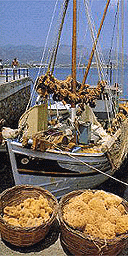
It is also close to the grin on the face of Kalymnian sponge divers in their traditional dance the mihanikos , as Faith Warn describes it in her book on their trade, Bitter Sea. The dancers, whose industry is older than Homer, begin in an athletic frenzy of youth. Then the leader falls crippled, mimicking the onset of nitrogen poisoning, which once killed a majority of divers. Yet the dance closes with his resurrection to vigour and beaming joy. In this resilient, eternal exuberance and defiance, the divers are ancestors to the human spirit which shines out of the kouros.
Sculpturally, the figure is considered unique by archaeologists as the only clothed kouros ever found in Greece. A scattering of other kouroses exist, mostly in the great museums of the world, but almost all are flagrantly nude. The British Museum has part of the head of one and the torso of another.
One final awkward possibility lies ahead for the Athens archaeologists. The warrior of Kalymnos may yet turn out to be a woman. Its hands, arms and feet are in the standard position for a kouros . But clothing has so far been found only on the kore , the female version of the genre thought until now not to have emerged until a century later.
If the statue is female, it will join the other island's other defining legend, the Lady of Kalymnos. Everyone discerns the profile of her thrown-back head in the contours of Telendos, opposite the beaches of Myrties, Melitsaha and Massouri. According to legend, she died waiting for her fiancé to return from war - or sponge diving. She, too, has had verses dedicated to her, among them by the modern Greek poet Tassos Leivaditis:
Awake, Lady of Kalymnos, awake with three bitter lemons,/and give us your braids to weave our sails,/ send us a kiss that we may sail with a fair wind./ Don't you hear the waves, slender and tall Lady of the sea?/Don't you see that the winds fight for your sake/and from their masts, far away, with their white caps,/the young sailors of the east wind greet you from the skies?
Yet even her mesmerising crag, thrown up by earthquake in 554AD, is 1,000 years younger than the little, heavily-disputed figure, which sits in a dark museum room waiting to give up its secrets.
As for Laskarina: our needs that week proved to be above and beyond the call of normal duty. They included fluency in Greek, intimacy with Kalymnian life, history and culture and a lot of patience. Laskarina's local agent Debbie Faulkner supplied these as naturally as if we were asking what sun oil to use or taverna to visit (and we did have time to do those things as well).
Way to go
Laskarina (01629 822203/4, www.laskarina.co.uk) offer a two-week stay at the Villa Spiros on the waterfront at Myrties on Kalymnos for £435pp, based on four sharing, inc flights and transfers. The company has 30 properties on the island and more on other Greek islands. The website for Kalymnos is www.kalymnos-isl.gr. Introductory summaries of knowledge about the kouros and kore are at www.getty.edu/art/collections ; the British museum website is at www.thebritishmuseum.ac.uk/compass; the Greek ministry of culture site at www.culture.gr/. Bitter Sea, by Faith Warn, is published by Guardian Angel Press, PO box 5883, South Woodham Ferrers CM3 5AH, £5.95 (inc £1p&p) or from www.amazon.co.uk.
